On this day back in 1493, noted explorer Christopher Columbus, while sailing near what is now the Dominican Republic, noticed something shocking. Grabbing his log book, he wrote, “…when I was going to the Rio del Oro, I saw three sirens that came up very high out of the sea.”
Sirens.
Not the woo-woo kind you see atop firetrucks, ambulances, and police cars, but the kind Homer wrote about in ‘The Odyssey’ or the Greeks sing about in their legends. The mythical half-woman kind, famous for luring sailors to their deaths with their enchantingly beautiful singing voices, typically residing on a rocky island in dangerous waters.
In other words, a mermaid.
Columbus believed he had spotted a mermaid.
While we might scoff at the notion, in Columbus’s day and age, the notion of a mermaid was nothing new, and it certainly was not fantastical. Back then, the ocean was thought to be full of krakens, sea serpents, and other types of monsters. Mermaids, for all their charm, were an especially dangerous and prolific type of water hazard.
The first mention of mermaids actually appeared in cave paintings dating back to the late Paleolithic (Stone Age), about 30,000 years ago, when humans first began to sail the sea. By the time the Greek Empire came along in 800-146 B.C.,mermaids had found their “origin story.” Myths claimed the creatures had become half fish and half woman after a dispute with the Muses. Angry and vindictive, mermaids were said to appear in a group of two or three, sitting on reefs waiting for the arrival of ships, where they could use their voices to entice sailors to their deaths. So serious did ancient sailors take this warning that many maps were marked with images of the half-woman, half-fish creature, reminding men to take heed.
But mermaids were not just a western legend. Mermaid-like creatures can also be found in myths and stories across many ancient cultures, from the Middle East, where Atargatis, a Syrian goddess who ruled the seas, was consecrated and worshiped with fish in temples full of large ponds; to China, where mermaid tears were said to harden and become pearls.
And sightings of mermaids were not uncommon. Many sailors, returning from months if not years at sea, passed along eyewitness accounts of these mythical creatures. In 1614, British explorer John Smith (of Pocahontas fame) claimed to have seen a mermaid in the Caribbean, writing in his log that he’d “begun to experience the first effects of love” when the creature turned over.
So, what exactly were they seeing? What did Columbus himself see?
We can’t know with 100% certainty. But many scientists believe they have the answer.
The accounts were either completely fabricated. Or, the sailors were seeing manatees.
Also know, affectionately, as sea cows.
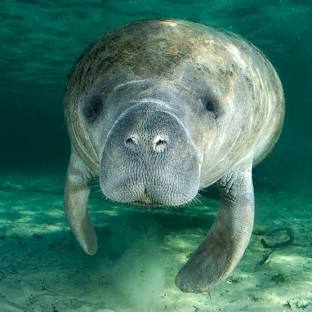
Huh?
I know. I had the same reaction. Not saying a manatee isn’t cute in its own way, but how could men mistake a a large, whiskered, slow-moving marine mammal for a half-human mythical creature?
Scientists claim, when seen from a distance (as most sailors refused to get too close), manatees have a “humanoid” shape, owing to their large head and expressive eyes, as well as a “fish” shape (think paddle flippers and rounded rear). This, coupled with the solitary nature of being a sailor, could easily fool an intimacy-starved man, according to Anthony Piccolo, a literature professor at Manhattanville College in New York. “Anything in the water became a projection of the sailors’ need for contact,” he said.
Seems a little out-there. But, then again, I’ve never been out at sea for months upon months on end.
One interesting piece of evidence, however, to strengthen the argument against mermaids and for manatees? In that same journal entry, Columbus noted: “They were not as beautiful as they are painted since, in some ways, they have a face like a man.” 😂
 jennwrightwrites.com